
Yorkshire Beekeepers Association members may find the recent BBKA Yellow Legged Asian Hornet (YLAH) coordinators’ meeting particularly useful, especially given the growing concern around confirmed northern sightings and increasing awareness work across Yorkshire. The discussion focused heavily on practical local action, public engagement, monitoring strategies, volunteer coordination, and concerns around communication from national agencies.
Key updates and points relevant to Yorkshire members
North Yorkshire experiences and lessons learned
Louise Hampson from Ryedale Beekeepers Association shared important reflections following the confirmed nest in Langton last year. The nest was successfully destroyed and, as far as they know, no secondary nests were identified. However, Ryedale members remain cautious and have increased monitoring and awareness work considerably.
One particularly significant point for Yorkshire members was the suspected route of introduction. Louise explained that the Langton nest may have arrived via horse racing transport, with horses, hay, trailers and associated equipment travelling from continental Europe into North Yorkshire racing yards. Once the risk to high-value racehorses was explained, stable managers became highly engaged and cooperative.
This is especially relevant for Yorkshire because of the county’s strong racing links through areas such as Malton, Middleham, Wetherby and Doncaster.
Huddersfield and West Yorkshire preparations
Lizanne from Huddersfield and District Beekeepers explained that, although West Yorkshire has not yet had direct YLAH incidents, local associations are actively preparing. Their group has ordered 100 monitoring stations and intends to coordinate a focused summer monitoring period when worker hornets are most likely to be detected.
Huddersfield members are also:
- promoting the Catch app,
- attending local agricultural shows,
- using preserved hornet specimens and posters for awareness,
- encouraging coordinated monitoring rather than constant year-round activity.
The discussion acknowledged that maintaining volunteer enthusiasm is difficult in areas without confirmed sightings yet, but members stressed the importance of “proving it isn’t here” through organised monitoring.
Growing concern about transport routes
Several coordinators raised concerns that YLAH spread may increasingly occur through transport and trade rather than natural expansion alone.
Particular risks highlighted included:
- imported plants and compost from the Netherlands,
- horse transport from continental Europe,
- garden centres,
- haulage routes linked to Hull and Liverpool ports.
This is especially pertinent for Yorkshire because of major freight and transport corridors running east-west across the county.
Education project involving schools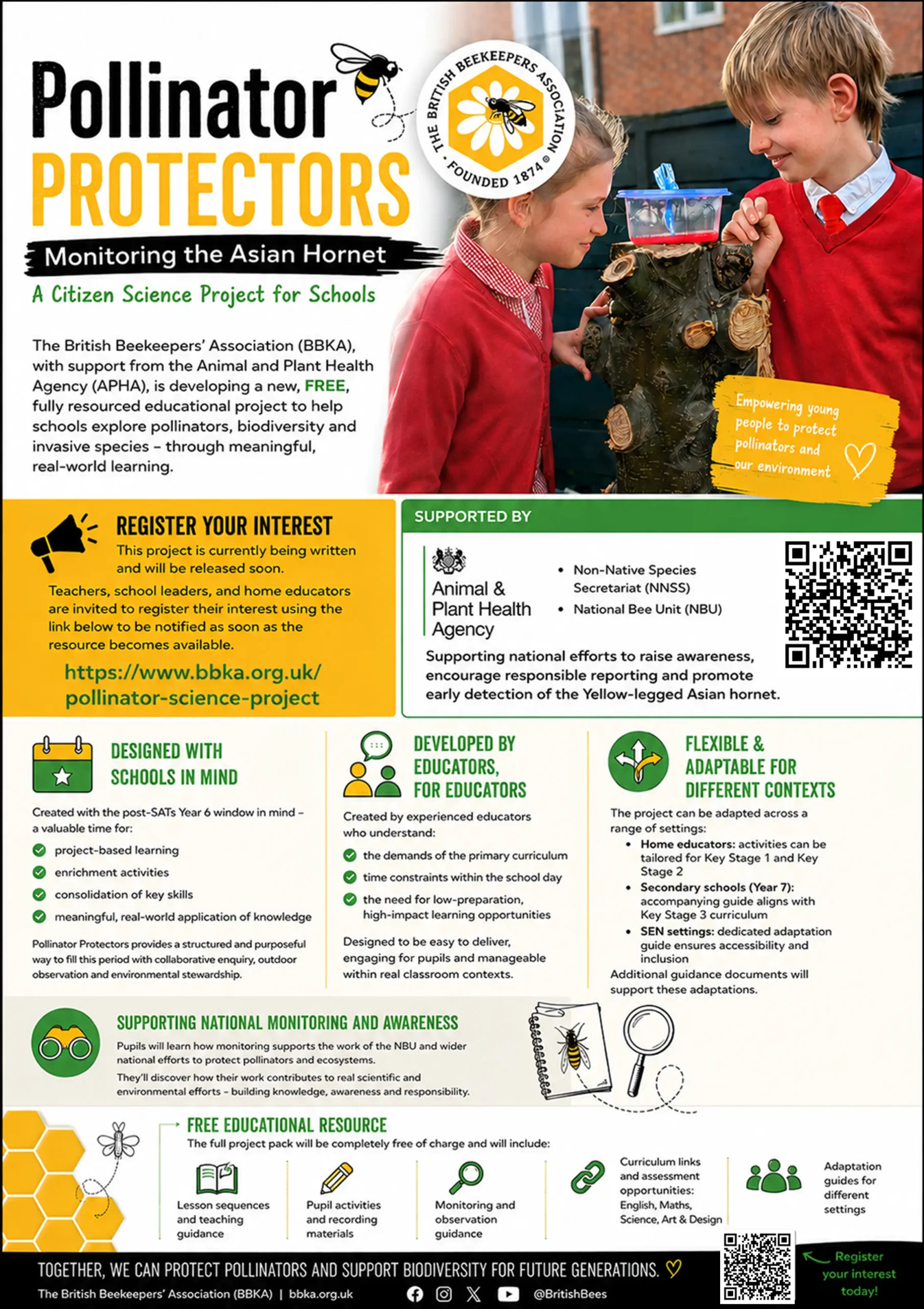
One of the most positive developments discussed was the BBKA “Pollinator Protectors” education initiative, aimed primarily at Year 6 pupils. The programme encourages children to build monitoring stations and learn to identify pollinators and invasive species, including YLAH.
The project includes:
- ready-made lesson plans,
- videos,
- worksheets,
- cross-curricular activities linked to the National Curriculum.
For Yorkshire associations involved with schools, outreach events or community education, this could become a very useful engagement tool.
Schools should sign-up here: https://www.bbka.org.uk/pollinator-science-project
Local districts are encouraged to try and find the capacity to support their local schools with the delivery of the project. Easier said than done, I know. Maybe a starting point may be to see if there are any members in your district that have current or previous links to education and schools.
Recurring themes from across the country
Several themes emerged repeatedly throughout the meeting:
Volunteer fatigue
Many groups reported that maintaining long-term volunteer engagement is difficult, especially in areas without sightings yet.
Public awareness works best locally
Garden centres, allotments, agricultural shows, racecourses, parish councils and local markets were repeatedly mentioned as the most effective places for engagement.
Misidentification remains a major issue
Multiple coordinators reported large numbers of false alarms involving European hornets. Several speakers noted that the term “yellow legged hornet” can actually confuse the public because the yellow legs are difficult to see at distance.
Frustration over communication
There was considerable frustration expressed regarding delays and lack of detailed local sighting information from national authorities. Several coordinators felt local groups need faster notification of nearby verified sightings in order to mobilise monitoring effectively.
Interesting developments discussed
Buzzcopper AI monitoring
Patrick Curry provided an update on “Buzzcopper”, an AI-based monitoring system designed to observe bait stations automatically and reduce volunteer workload. More than 1,200 devices have reportedly already attracted interest.
Use of thermal imaging
An ecologist from Gloucestershire highlighted increasing use of thermal imaging cameras and drone technology to identify nests in trees.
Funding from parish councils
Some associations are successfully securing funding from parish councils for monitoring equipment and awareness work.
Overall message for Yorkshire members
The overall tone of the meeting was clear: Yorkshire may still be relatively lightly affected compared with southern counties, but coordinators increasingly believe spread northwards is inevitable. The emphasis now is on:
- awareness,
- targeted summer monitoring,
- local partnerships,
- early detection,
- avoiding volunteer burnout,
- and improving public understanding of what YLAH actually looks like.
My thanks to the YBKA members who represented our views in my absence.
Sections of the recording Yorkshire members may wish to watch
For members short on time, these sections are particularly worthwhile:
- 03:35 to 05:50 – Pollinator Protectors school project and education initiative, including curriculum-linked resources.
- 24:30 to 31:30 – Huddersfield Beekeepers update on Yorkshire preparations, monitoring plans and Catch app use.
- 36:00 to 40:30 – Ryedale Beekeepers discussion about the North Yorkshire nest and concerns around horse transport.
- 49:30 to 57:00 – Discussion about imported plants, garden centres and transport routes from the Netherlands.
- 58:00 to 1:05:00 – Excellent discussion on public engagement, ecologists, thermal imaging and wider countryside awareness.
- 1:06:00 onwards – Open discussion about challenges facing coordinators, including volunteer fatigue, verification systems and frustrations around communication.