
Asian hornets represent one of the most serious emerging threats to honeybees in the United Kingdom.
These invasive predators, originally from Southeast Asia, have spread across Europe and are now appearing in Britain with increasing frequency. Their impact on pollinators is profound, but new research offers a surprising and hopeful tool. Sound.

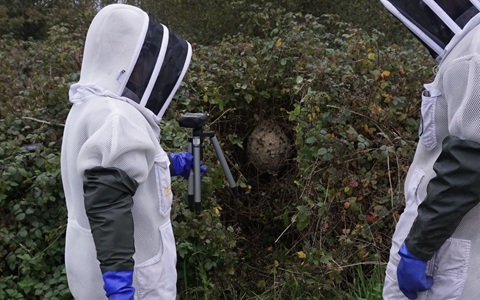
Scientists at the University of Southampton have discovered that Asian hornet nests produce a unique acoustic signature. This means their presence can be detected through sound analysis before nests become large or widespread. This discovery could transform how authorities respond to the invasion and protect bee populations.
Asian hornets prey directly on honeybees. They hover near hive entrances and capture worker bees as they return from foraging. Over time, this relentless predation weakens colonies, reducing pollination activity and threatening hive survival. In severe cases, entire colonies collapse.
Honeybees are essential to agriculture and ecosystems. They pollinate crops such as apples, strawberries, and oilseed rape. Without them, food production declines and biodiversity suffers. Protecting bees is therefore not only an environmental priority but also an agricultural necessity.
Traditional methods of detecting Asian hornets rely heavily on visual sightings and manual tracking. These methods can be slow and limited in scope. Hornet nests are often hidden high in trees or difficult locations, allowing populations to grow unnoticed.
The discovery of acoustic detection changes this dynamic. Researchers found that hornet nests produce a consistent sound frequency distinct from bees and other insects. With specialised microphones and sensors, monitoring systems can detect this frequency and pinpoint nest locations faster and more accurately.
This approach offers several advantages. First, it enables earlier detection. Removing nests early prevents hornets from multiplying and spreading. Second, it improves efficiency. Authorities can focus resources where hornets are confirmed rather than searching blindly. Third, it enhances prevention.
Monitoring systems could eventually operate continuously, providing real‑time protection.
This research reflects a broader shift in conservation.
Technology is becoming a powerful ally in protecting wildlife. From acoustic monitoring to artificial intelligence, new tools help scientists understand and defend fragile ecosystems.
However, technology alone cannot solve the problem. Public awareness remains critical. Many hornet detections come from ordinary people reporting sightings. Beekeepers, gardeners, and walkers all play a role in protecting pollinators.
The story of Asian hornets in Britain is not only about invasion. It is about adaptation. It demonstrates how science, technology, and public engagement can work together to address emerging environmental threats.
By learning to listen to the hidden sounds of nature, researchers are opening a new frontier in conservation. In doing so, they offer hope that honeybees, and the ecosystems they sustain, can continue to thrive in the years ahead.