
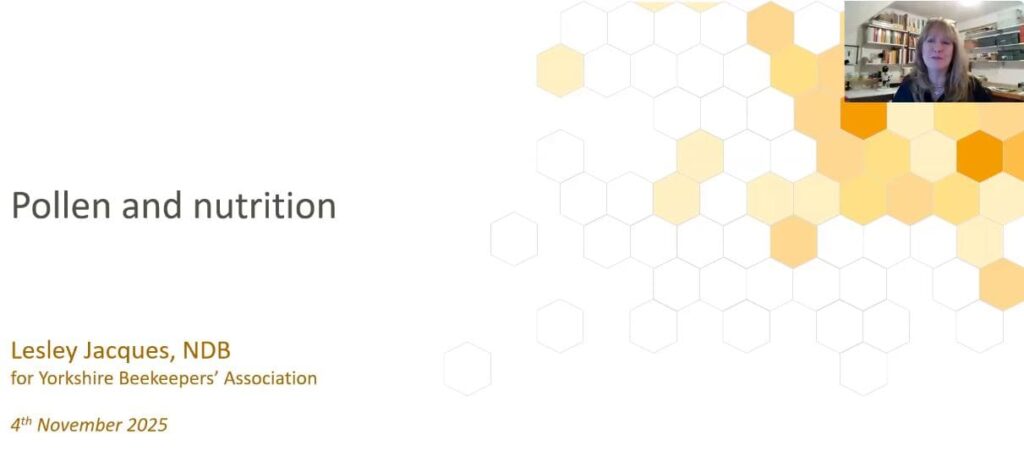
It was an evening that began with a touch of chaos. At seven o’clock sharp, Yorkshire Beekeepers’ webinar room was full, but the speaker was missing. Elaine Robinson, ever the calm host, apologised for the delay and suggested everyone rejoin at half past seven. The culprit, it turned out, was not technology – but a simple mix-up over the start time. When Lesley Jacques appeared, she was her usual warm and unflustered self: “Terribly bad form for the speaker,” she laughed. “But at least everyone’s in now!”
And it was worth the wait.
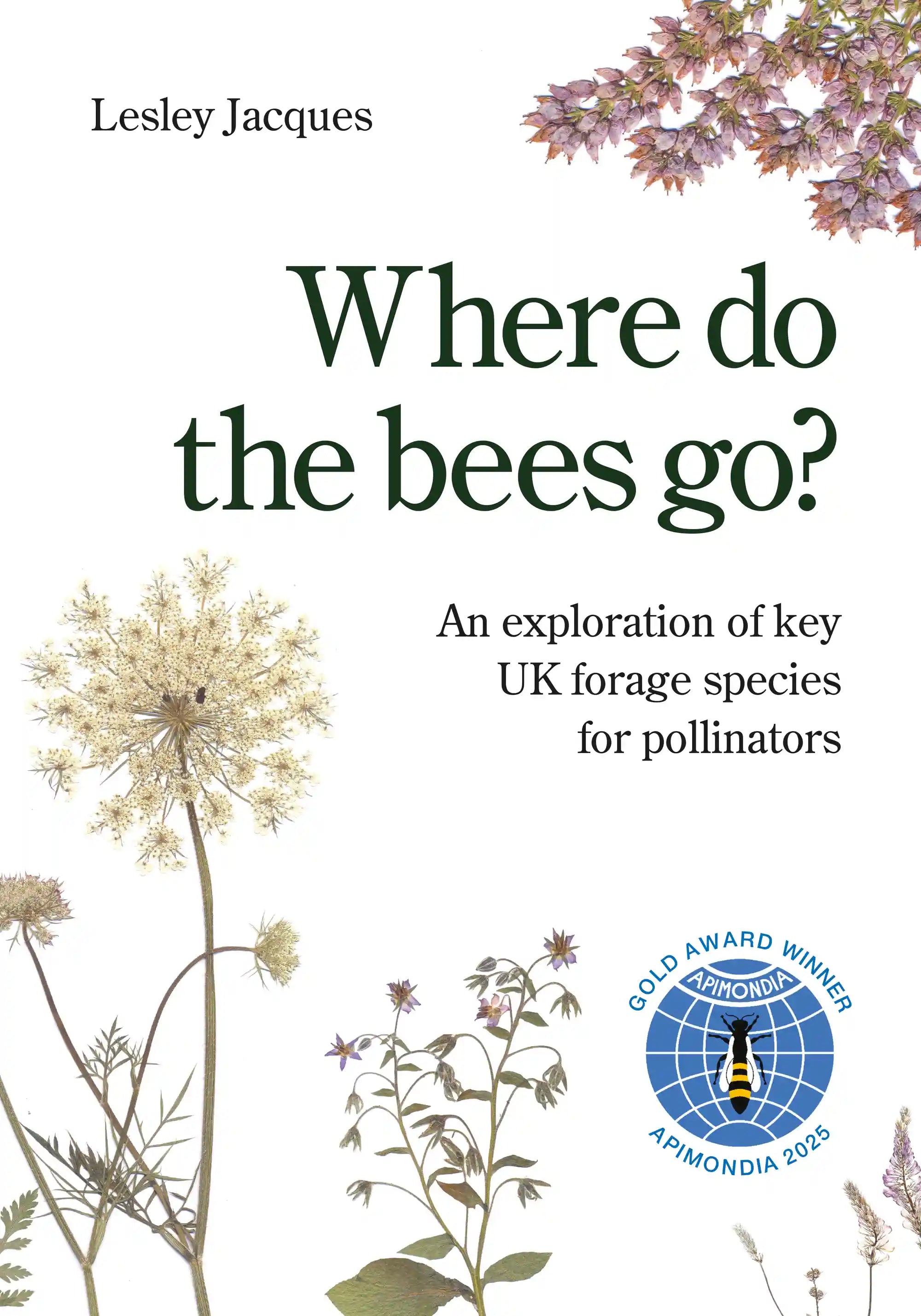 Lesley, Vice-Chair of Cheshire Beekeepers, Master Beekeeper, and holder of the National Diploma in Beekeeping, spoke with authority and humour on Honeybees, Pollen and Nutrition – a talk that wove together botany, microscopy, and the practical realities of colony management. Her award-winning book Where Do the Bees Go?, which took gold at Apimondia, explores similar themes: the interplay between pollinators and the plants they depend on.
The hidden life of pollen
Pollen, Lesley explained, is far more than a dusty nuisance for hay-fever sufferers. It is the male reproductive cell of flowering plants – tiny, intricate structures that carry the genetic promise of new life. Most grains are only 25–30 microns across, invisible without a microscope. Yet their diversity is staggering: smooth or spiked, spherical or boat-shaped, each grain carries the fingerprint of its parent plant.
A scanning electron micrograph of a pollen grain clinging to a lily’s stigma offered a glimpse of what Lesley called “a little bit of plant magic”. When moistened, a pollen grain sprouts a microscopic tube down the flower’s style to reach the ovary – “gratuitous plant sex for a Tuesday night,” she quipped to much laughter.
Why pollen matters to bees
For honey bees, pollen is life. It is their principal source of protein – fuel for brood rearing, for building tissue, and for the production of royal jelly and brood food. Colonies may collect 50–100 lb of pollen in a season, storing it as bee bread – a fermented mix of pollen, honey, and enzymes with a yoghurt-like acidity that preserves it against decay.
Lesley’s data showed that not all pollens are equal. Dandelion, though abundant and beloved by bees, is relatively poor in protein (around 15–20%). In contrast, early-flowering trees like goat willow, horse chestnut and bird cherry can approach 40%. “If you want to plant for pollinators,” she urged, “plant trees. Bird cherry, willow, apple – these are powerhouses for spring protein.”
That early-season protein is critical. As colonies expand rapidly in March and April, the larvae often outnumber the adult bees. If pollen stores are low, brood rearing stalls. Lesley advised checking spring colonies for stored pollen and, where necessary, offering a pollen supplement or substitute – “a simple act of good husbandry that can make all the difference to colony build-up.”
Supplements, substitutes and beekeeper judgment
Lesley distinguished between pollen supplements (feeds containing real pollen, such as Candipolline Gold) and pollen substitutes (recipes using soya flour and brewer’s yeast). Bees prefer the real thing, but either can bridge a dearth. Feeding in late winter can also stimulate brood rearing ahead of oilseed rape or early forage crops – but, she cautioned, not all beekeepers need to do so. “If your bees are small, thrifty, or you’re in an area rich in spring forage, let them follow their instincts. Over-complicating beekeeping rarely helps.”
Seeing pollen through a beekeeper’s lens
 Lesley’s fascination with pollen began through microscopy, and she remains one of the country’s foremost enthusiasts. She described how to prepare slides from flowers, pollen loads, or even honey samples using nothing more elaborate than a coffee-cup warmer, a drop of glycerine jelly tinted with fuchsin stain, and – her favourite secret – clear nail varnish to seal the coverslip.
Under the microscope, each grain becomes a world of pattern and geometry. Using Rex Sawyer’s Pollen Identification for Beekeepers, Lesley demonstrated how size, shape, apertures, and surface texture combine into a “morphological code” that reveals the plant of origin. Her passion for slide-making borders on the epic: when asked how many she had created, she gestured to boxes and cabinets stacked behind her – “A couple of thousand? Probably more. Let’s just say… quite a lot!”
The stories pollen tells
Pollen analysis, or melissopalynology, is more than a hobby – it is a powerful tool for understanding honey. By identifying the pollens suspended in honey, beekeepers can determine its floral sources and even detect fraud. True heather honey, for example, must contain a high proportion of heather pollen; if that is absent, something isn’t right.
However, Lesley reminded listeners that some plants are “over-represented” or “under-represented” in honey. Sweet chestnut pollen appears in abundance, while lavender or rosemary may be scarce even in pure varietal honeys. “Like everything in beekeeping,” she smiled, “it depends.”
A botanist’s treasure hunt
The latter part of the talk explored pollen identification across plant families – from the spiky grains of daisies and sunflowers (Asteraceae) to the delicate ovals of clovers and the umbrella-shaped umbels of wild carrot and hogweed. Lesley recommended building a reference collection of slides: “Once you start, you can’t stop – but it’s wonderfully addictive.”
Her detective work once led her to discover catalpa (Indian bean tree) pollen in her summer honey – a clue to a hidden garden tree somewhere near her apiary. “I haven’t found it yet,” she said, “but I know it’s there.”
Tools, books and a spirit of curiosity

For those eager to explore further, Lesley recommended Pollen Identification for Beekeepers and Honey Identification by Rex Sawyer, Microscopy for Beekeepers by Bob Maurer, and Norman Chapman’s Pollen Microscopy. Dorothy Hodges’ classic Pollen Loads of the Honey Bee, though rare and costly, remains “a thing of beauty.”
Asked about the future, she mused on her ambition to build a comprehensive UK reference set: “Perhaps when I retire – I’ll need time to travel south for the species we don’t get in Cheshire!”
Questions from the floor
The Q&A ranged from UV vision (“Bees see towards the ultraviolet – our reds look very different to them”) to slide-making tips and the mysteries of bee hoarding behaviour. When asked about her National Honey Show entries, Lesley shared that she chooses “pollens that are nice to look at” – Scots pine, ling heather, catalpa – “never oilseed rape; it’s round and dull!”
As the evening closed, Elaine Robinson thanked Lesley for a talk that was “fascinating, informative and beautifully delivered.” It had been, despite its late start, a night of science, craft, and quiet wonder – reminding everyone just how much is hidden within a speck of golden dust.
About the speaker:
Lesley Jacques is Vice-Chair of Cheshire Beekeepers, a Master Beekeeper, and holder of the National Diploma in Beekeeping. Her book Where Do the Bees Go? – winner of gold at Apimondia – is available from Northern Bee Books.